Storm on the Gulf: A Labor Day Fishing Tale (1969)
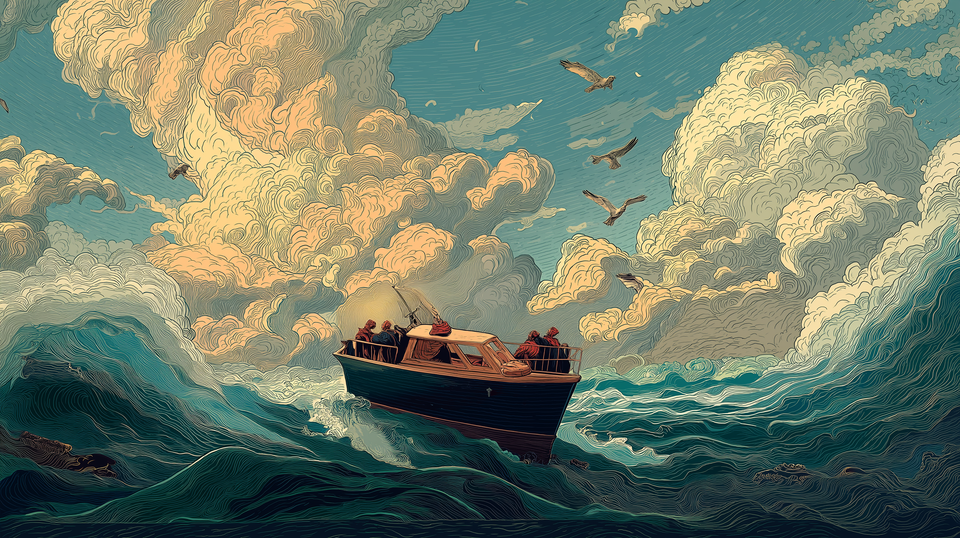
At 14 years of age, I thought a day fishing with my dad was just another adventure – until the sky turned purple and the Gulf tried to swallow us whole!
At 45 years of age, my Dad was a 5’9” tall veteran of WW2, Korea, and Vietnam all with the U.S. Navy and he was muscular and rough and tough, barely weighing 150 pounds. His favorite pastime was fishing. As a six-year-old I remember Dad making a gill net and building a small ten-foot wooden boat from scratch. He used to take me out on the lakes of East Tennessee putting the nets out and he even had me steer the boat and control the throttle while he put out the nets. So, when it came to dealing with water, he was an expert. He even taught sea survival to student pilots during his naval career.
In 1968 Dad bought a 21-foot Scottie Craft wooden boat that had been built in the 1950s. It was his proudest moment. Week after week, we would head out to the Gulf. We were used to the whims of the water, and I learned about currents, tides and following seas (which happens when the water is pushing you in the same direction you are heading). Dad was always teaching me when we were together.
I was about 14 years old on that sultry Labor Day. The plan was to leave the dock, head down the bayou into the bay and through the often-troublesome Pass. The Pass is a 2.5 miles wide strip of water that lies between two barrier islands but the navigation channel is 800 feet wide. It was often choppy and sometimes ships would be incoming as we were heading out. So, transiting the Pass was often stressful.
Once we made a mile out in the Gulf, we started trolling. Looking into the water we would see porpoise just below the surface as though they were personal escorts, looking me right in the eye! Sometimes the water was so clear we could see the bottom of the Gulf some 30 feet below. We landed a few bonito, a small tuna good for fighting but not for eating.
Dad told me, “I’ve got an itch for mahi-mahi. Let’s make a run further out.” Ergo, we headed a further ten miles out and as we went, we saw flying fish – a good sign that some predator fish like mahi-mahi were around.
“Look over there Ricky, son – that is a tide line. The mahi-mahi like to hide under the shade of the debris." He took down the throttle and got close enough where he could cast a cigar minnow on his hook. After fifteen minutes he hooked a fish.
It was mahi-mahi and made a long run. The drag on the rod rang loudly and rapidly clicked away yards of monofilament fishing line. After ten minutes of fighting the fish was worn out and Dad brought him on board. Dad may have tired this beautiful fish but taking it out of the water reinvigorated it, whipping up a small tempest. “Stand back son!” said Dad and he clubbed the fish into submission.
It was the first time I had seen mahi-mahi and it was mesmerizing. When the fish are alive, they are gloriously colored with greens, yellows and blue. I winced as Dad clubbed the fish, those electric colors began fading away like a dream at dawn, leaving me wondering if beauty always dies so quickly.
Today we were happy with the one 15-pounder. After a quick sandwich, we started heading back toward shore, putting out our rods for a slow troll on our way home in hopes of catching a kingfish or two. Hours passed with little action and the sea swells increased a bit causing us to dip below the horizon on occasion.
After another hour we noticed clouds gathering and, in the distance, the clear blue sky was shifting to deep purple off to our west. We saw a waterspout in the distance in the general direction of the Pass.
I had never seen any concern while out on the Gulf waters but something about today was different. Dad calmly said, “let’s bring in our lines and head to the Pass.” But we did so with great urgency. He cranked up the throttle, but that old marine diesel just did not make much speed. The increased wave motion was beginning to make me feel a bit queasy and it was made worse by the diesel fumes wafting over the transom into the cabin. We could have used those porpoises about now!
After a few miles it was obvious, we were about to be caught in the storm we had been trying to evade. The salt of the sea spray was hitting my face and caking on my skin. It was not the first time we had been in a storm, but now the situation was becoming ominous.
Dad was dry at the wheel, and I was beside him in the other seat getting soaked. Little by little, the old wooden boat was being lifted with each pounding wave. Minutes later and nearer to the mouth of the Pass the old wooden boat shuddered and when it lifted, the engine would race as the prop left the water, and the boat would then crash back down. We could tell the boat was taking a beating as it groaned and strained after each cycle of the waves.
As the rain poured down in torrents and lightening flashed intensely, we found ourselves in a predicament. The tide was going out of the Pass meaning our forward progress was being slowed. At the same time the winds from the storm were pushing our stern. The result was significant lifting and crashing down, sometimes violently. We were now bobbing in a very unsafe manner with little forward progress.
I dealt with the stress by pretending to be on the back of a bucking bronco. I was not oblivious to the danger, yet I had complete trust with my dad in charge. And slowly, sometimes violently we made it through the Pass into a safe harbor.
Dad wisely told me, “No need to tell Mom about the storm!” I never mentioned it. The family ate mahi-mahi that night and it was delicious.
But the adventure was not yet over. The phone rang early the next morning. It was the dock manager telling dad he needed to get over to the dock ASAP – the boat was sinking. Dad woke me up that morning and said, “Ricky, son, get dressed we have to get to the dock right now – the boat is sinking!”
I threw on some shorts and a tee shirt leaving so quickly I almost forgot my shoes. Once we arrived, the situation was not as serious as feared but the water in the bilges told the story. Dad turned on the pumps and waited but realized the pumps could barely keep up.
Then Dad gave me the bad news, “Rick, we have to trailer the boat today!” That was in itself an ordeal. It was about as large a boat as was allowed to be trailered at the time. And it meant we had to take the boat to a boat launch site so we could back the trailer down and winch up the boat which we efficiently accomplished that afternoon.
Once on the trailer, we brought the boat home and parked it in the back yard. Dad did not have the money to repair the boat. Mom complained about the boat just sitting in the back yard, year after year all through throughout the seventies.
Dad once told me, “If I can’t use it, nobody can.” Shortly afterwards, he started dismantling the boat by removing the electronics, the compass, the steering wheel, and then the beautiful mahogany pieces from the decks. Within the year of 1980, he managed to dismantle the boat and haul large sections of it to the dump until all that was left was the trailer.
I think there is nothing sadder than a trailer for which there is no boat - except maybe a sailor without a boat!